

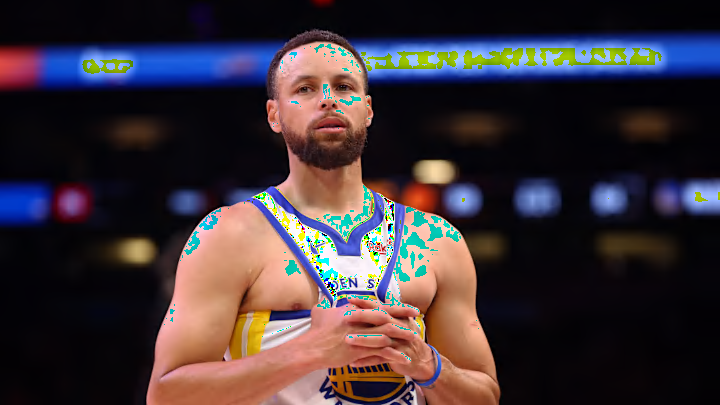
The Golden State Warriors did not go out with a fight. They went out in the NBA Play-In, a stage that once felt far beneath a franchise that defined an era and dictated how modern basketball is played.
Stephen Curry is still performing at an elite level (like the first play-in game), still capable of taking over stretches of games and bending defenses in ways that remain unmatched. Yet those performances are increasingly detached from outcomes, no longer translating into meaningful postseason success.
However, it ends in seasons that fade earlier than expected and leave more questions than answers. The final play-in loss against the Phoenix Suns was devastating. That contrast between two games is becoming harder to ignore and even harder to watch.
The Golden State Warriors are slowly deteriorating
This is no longer about a single bad season or an unfortunate stretch of injuries. It has become a pattern, one that defines how the Warriors operate from week to week, never quite stable, never fully in rhythm, and constantly adjusting to absences that disrupt any sense of continuity.
Curry himself is now part of that reality. While still dominant when available, he is dealing with more frequent injuries, missing time in ways that force the team to recalibrate repeatedly. Even short absences carry weight, because the margin for error has disappeared, and Golden State no longer has the depth or structure to absorb those gaps.
The result is a team that can compete on any given night. However, one that cannot sustain that level over time. In the playoffs, or even just to reach them convincingly, that distinction becomes decisive.
The Warriors chasing Giannis Antetokounmpo is a risky gamble
Golden State’s interest in Giannis Antetokounmpo signals ambition, but it also reveals something deeper about the current state of the franchise. The Warriors are no longer operating from a position of control, building around a system they trust, but are instead looking outward for a solution that may never materialize. That is a risky place to be.
Giannis might never become available (or choose to go somewhere else), and even if he did, the cost would reshape the roster in ways that are difficult to predict. Chasing that possibility without a clear alternative leaves the Warriors in a holding pattern, caught between what they were and what they are trying to become.
So, currently, they are not bad enough to tank a good player (and this will also be harder in the future) and are relying on their questionable ability to gain a new superstar to revive the franchise. They chase a summer, which might change all of this. It resembles more gambling than a long-term strategy.
The Warriors can no longer ignore their gradual collapse
This is not a sudden fall. It is a gradual collapse, one that has been unfolding over several seasons, marked by indecision, short-term fixes, and a lack of clear direction at the top.
The Warriors are not just losing games. They are losing clarity, losing identity, and most importantly, losing time with a player who still belongs at the very top of the league. Curry’s prime is not gone, but it is being eroded, piece by piece, by a structure that no longer supports it. At some point, responsibility shifts upward.
When a franchise wastes the closing years of one of the most gifted players to ever touch a basketball, questions about management are no longer optional. They become necessary, because what is happening now is not just unfortunate. It is avoidable.
And unless something changes at that level, this slow fade will continue, right in front of a player who deserved a better ending.
 Add us as a preferred source on Google