

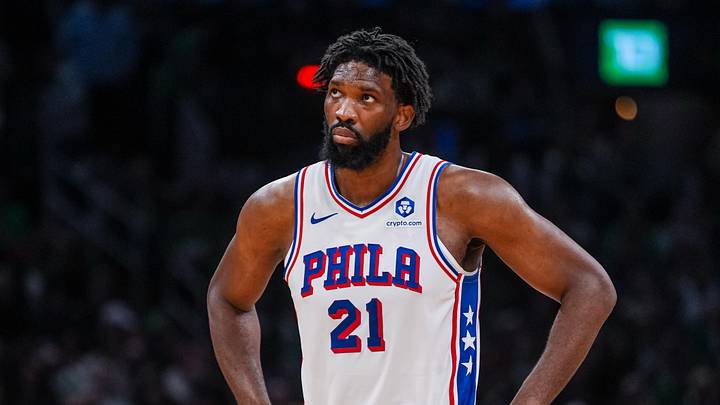
The Philadelphia 76ers were not supposed to win this series. Not against Boston, not as the lower seed, and certainly not under the circumstances they were dealing with. And yet, here they are. And they have beaten Boston in a series for the first time since the 80s.
Beating the second-seeded Celtics in a Game 7 has completely changed the tone around this team, turning what once looked like a lost season into something far more ambitious. The fan base is dreaming again.
Not cautiously, but openly, because when you take down a team like Boston, the ceiling suddenly feels much higher than it did just weeks ago. But the question is no longer what they just did. It is whether they can do it again.
Joel Embiid turned the series into something personal
Everything starts with Joel Embiid, and in this case, everything changed because of him. After missing most of the regular season and undergoing an appendectomy shortly before the playoffs, his return in the middle of the series could have been limited, cautious, and gradual.
Instead, it was decisive, almost overwhelming, as he stepped back onto the court and immediately took control in a way that resembled a Finals MVP performance rather than a player returning from surgery.
He did not ease into the moment. He defined it. That kind of impact shifts everything, but it also raises the most important question moving forward: can he sustain it?
The Philadelphia 76ers supporting cast rose exactly when needed
Embiid was the centerpiece, but this was not a one-man series. Paul George, returning from a suspension related to banned substances, delivered when it mattered, bringing scoring and composure that helped stabilize the team in critical stretches.
Tyrese Maxey was spectacular, playing with pace and confidence, while rookie VJ Edgecombe stepped into the spotlight with a level of fearlessness that did not match his experience.
Even Kelly Oubre, who did not dominate the stat sheet, played a role that mattered. His energy, physicality, and willingness to get under Boston’s skin disrupted rhythm and added an edge that does not always show in numbers but becomes visible in how a series unfolds.
The Boston Celtics never fully found their rhythm
For the Celtics, the series never quite aligned. Jayson Tatum, returning from a long Achilles injury absence that kept him out for most of the regular season, struggled to find a consistent rhythm, and that inconsistency echoed throughout the team.
Boston had the talent, but not the cohesion, especially in the moments where execution becomes everything. That opened the door.
Philadelphia did not just take advantage of it, they forced it wider, applying pressure in key moments and capitalizing on every stretch where Boston looked uncertain. By the time Game 7 arrived, the momentum had already shifted.
Can the Philadelphia 76ers sustain this level?
This is where reality sets in. Winning one series like this is impressive. Repeating it across multiple rounds is something else entirely, especially when so many variables remain uncertain. Embiid’s health is the biggest one, because everything depends on his ability to stay on the floor at this level of dominance.
Around him, the questions continue. Can Paul George maintain his balance and consistency? Can Oubre translate his toughness into more tangible production when needed? Can a rookie like Edgecombe continue to perform at near All-Star level under increasing pressure? And can Maxey fully embrace the role of leader among veterans as expectations rise?
Those are not small questions. They define the difference between a great moment and a championship run. If they answer those questions wisely, Sixers fans may hope.
 Add us as a preferred source on Google