

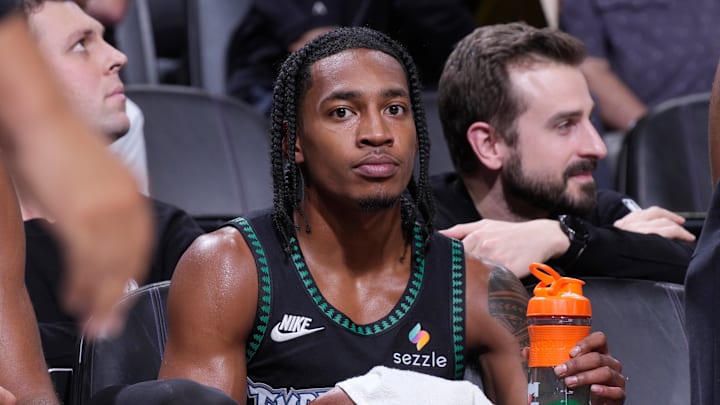
When the Minnesota Timberwolves aggressively moved up in the draft to select Rob Dillingham, the price gradually raised eyebrows. An unprotected first-round pick plus a future pick swap is the type of package usually reserved for players expected to contribute early or at least show clear star potential. Two seasons in, that bet looks increasingly difficult to justify.
Dillingham’s second year has done little to calm concerns. Instead of showing a leap, his role has shrunk, his minutes remain limited, and the impact simply isn’t there. For a team built to contend now, patience is not unlimited.
The production just isn’t there for Rob Dillingham
Through 28 games this season, Dillingham is averaging only 10.3 minutes per game. In that time, he’s producing 3.9 points, 1.9 assists, and 1.3 rebounds while shooting 35.5 percent from the field and 34.5 percent from three. Those are end-of-bench numbers, not the line of a player acquired at such a steep cost.
Even when zooming out to his entire NBA sample, the picture doesn’t change much. Across 77 games since last season, Dillingham is at 4.3 points per game in 10.5 minutes, with modest efficiency and minimal defensive impact. The flashes are there in theory, but they are rare and fleeting in practice.
For a guard whose calling card was supposed to be shot creation and offensive spark, failing to consistently bend the defense is a major red flag. Minnesota doesn’t need him to be a star, but they do need him to be playable. Right now, he’s barely cracking the rotation.
A crowded backcourt and shrinking runway for Rob Dillingham
Context matters, and the Timberwolves are not exactly desperate for developmental minutes. This is a team prioritizing winning (especially after two Western Conference Finals runs), structure, and defensive reliability. That environment is unforgiving for young guards who struggle with efficiency, decision-making, or physicality.
Dillingham’s size limitations show up quickly at the NBA level. Defensively, he’s often targeted. Offensively, he struggles to finish inside and doesn’t yet command enough respect as a scorer to open things up for teammates. Coaches can’t justify extended runs when every possession matters.
The result is a vicious cycle. Limited minutes lead to limited rhythm, which leads to more mistakes, which leads to even fewer opportunities. For a rebuilding team, that might be acceptable. For Minnesota, it’s not.
The trade cost changes everything for the Timberwolves
What truly seals Dillingham’s fate is not just his play, but the context of how he arrived. An unprotected first-round pick is the kind of asset that can reshape a franchise. When that player fails to contribute, the disappointment is magnified.
Fair or not, Dillingham will always be judged against what that pick could have become or what it could have been used to acquire. Fans understand development takes time, but they also understand opportunity cost. Right now, the return simply doesn’t match the investment.
That doesn’t mean Dillingham is done in the NBA. A change of scenery, a different developmental timeline, or a system that gives him more freedom could still unlock something. Rebuilding teams might be happy to welcome him. The Timberwolves took a swing. It hasn’t landed. He might be soon on the chopping block, with only a few weeks ahead of the trade deadline. The clock is ticking.
 Add us as a preferred source on Google