

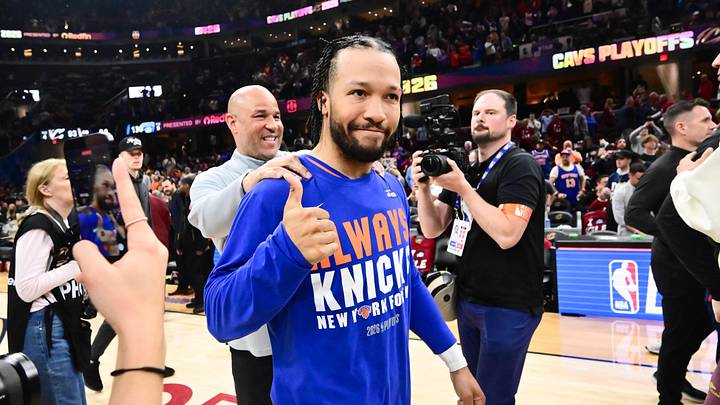
The New York Knicks arrived at the NBA Finals carrying a statistic that feels almost out of place alongside the franchise’s history. According to Keerthika Uthayakumar on X, New York owns a staggering average scoring margin of +19.4 during this postseason, setting a new record for any team entering the Finals.
Even the celebrated 2017 Warriors, often viewed as one of basketball’s modern gold standards, finished lower at +16.3. That alone invites comparisons, although the connection deserves nuance.
Golden State built a championship empire led by Stephen Curry, and the Knicks are not suddenly being crowned the next dynasty. Still, numbers like these force a different conversation. Rather than revisiting what the Warriors once were, the statistic may reveal what New York has quietly become.
This version of the Knicks feels unfamiliar
For much of the past two decades, Knicks basketball existed somewhere between tradition and frustration. The franchise remained culturally enormous, yet true championship ambitions rarely survived into late spring.
Their last Finals appearance came back in 1999 against the Spurs, a distant memory that shaped how generations of fans learned to approach hope. That history matters because New York supporters have grown used to emotional caution.
The Knicks often inspired passion, grit, and drama, but dominance was never part of the expected script. Numbers associated with elite contenders belonged to other organizations, not to a franchise more accustomed to rebuilding narratives than writing championship ones.
This postseason has challenged those assumptions. A differential approaching twenty points per game is not the result of fortunate bounces or isolated hot streaks. It reflects sustained superiority. The Knicks have not stumbled through the bracket, surviving close escapes.
They have controlled games, dictated tempo, and repeatedly imposed themselves on opponents.
The Knicks didn't stumble into their success
The current run also deserves perspective because it emerged through gradual growth rather than sudden reinvention. Many contenders require painful playoff lessons before reaching the sport’s highest level, and New York appears to have followed that pattern. Setbacks became experience, and experience eventually turned into composure.
Donovan Mitchell acknowledged that after Cleveland’s exit. The Cavaliers star openly praised New York’s development and suggested his own team hopes to build something similar. His comment resonated because basketball fans have heard comparable language before.
Philadelphia turned “The Process” into a defining identity, yet the Sixers never fully reached the promised destination. New York took another route entirely. Their rise lacked grand slogans and dramatic declarations. Instead, it depended on patient roster decisions, internal continuity, and repeated exposure to playoff basketball.
The Knicks' biggest challenge still remains
None of this guarantees the final step. The NBA Finals remain an entirely different challenge. They will face Victor Wembanyama and the Spurs. A Spurs matchup carries historical symmetry, given that San Antonio also stood on the opposite side of the Knicks’ last Finals appearance.
That uncertainty, however, may be exactly why the statistic carries emotional weight. Knicks fans traditionally celebrate effort while preparing themselves for disappointment. This year has introduced a different feeling altogether. Belief is no longer based only on passion or loyalty. The evidence increasingly supports it.
Across New York, that emotional shift is impossible to ignore. Madison Square Garden has become surrounded by celebration, online videos capture fans turning city streets and transit stops into impromptu parties, and optimism feels louder than skepticism for perhaps the first time in years. Statistics alone cannot secure a title.
But sometimes numbers hint at something larger. And for a franchise that spent decades chasing relevance, this postseason may be asking a question New York has long avoided: What if the Knicks are truly contenders?
 Add us as a preferred source on Google