

First of all, it’s just an unwritten rule: You don’t miss wide open dunks in transition … at home. If you do, and you end up losing by one possession, perhaps you should have unlimited hate mail sent to your house until the day you’re traded.
Seriously though, Marreese Speights had to feel like a useless human being for a couple hours after the Game 2 loss, just because he cost his team a couple points. But, we’re not blind to the fact that one play in the second quarter of a 53-minute game is very minuscule in the grand scheme of things.
Still, I’m sure Andre Iguodala (who initiated the sequence) would love to have the fastbreak back for himself, instead of passing it to the less athletic Speights, who looked like a snail trying to out-run a herd.

Game 2 of the NBA Finals is always one of the weirdest turn of events in the championship series.
Back when I was emotionally invested in the 2010 Finals as a fan, there was nothing more dreadful than seeing Boston walk into Staples Center and knot up the Finals at 1-1 against the title-defending Lakers. Sometimes, it puts a team into a psychological disadvantage — It’s daunting to be so close to taking care of business on your home floor and going up 2-0, but allowing the road team to steal a close Game 2 because of a Herculean effort.
Ray Allen buried eight 3-pointers in Los Angeles for Game 2 (five years ago), leaving the crowd a little stunned and upset that an opportunity was lost on the biggest stage.
Just one year later, in 2011, the Dallas Mavericks crashed a South Beach party in Game 2 of the Finals. Down 15 points in the fourth quarter, Dirk Nowitzki and Jason Terry put on their superhero capes and stormed back to tie the series at 1-1. If LeBron and Wade had went up 2-0 in that series, Miami probably hangs a banner in their first year together.
In 2014 (the third battle between James and Duncan), LeBron completely thrashed San Antonio for 14-of-22 shooting and 35 points in Game 2. It prevented the Spurs from heading to Miami up 2-0 in the series. For Warriors fans this year, they could definitely use last year’s series as an example — we all know what happened to LeBron’s Heat when they returned home with a desirable 1-1 split. It still didn’t matter:
We can't really freak out now, please ... LeBron won Game 2 last year in San Antonio
— Shane Young (@YoungNBA) June 8, 2015
The next three games? Lost by an average margin of 19
Sunday, in the 2015 Finals matchup, had a similar feeling to those Game 2 heroics.
LeBron’s Historic Finals
Nothing was different in regards to the player involved … it was LeBron, yet again. He’s played in 25 Finals games in the past five years, so it’s at the point where “one of his best Finals performances” is a phrase spewed all the time.
Nevertheless, these first two games of James’ 6th Finals appearance have been too special. It’s impossible not to gloss over them, despite the poor shooting percentages. Altogether, James has shot 29-of-73 from the field (39.7%) in 96 total minutes of play. That’s approaching 0.8 shots per minute, which indicates a huge burden being put on LeBron’s shoulders. For perspective, he averaged just 0.5 shot attempts per minute during the regular season and 0.68 in the East Finals.
The closer he gets to a championship, the more he’s accepting that he needs to take more shots, and impose his strength on smaller defenders. The LeBron from 2011 would’ve been more passive in so many situations, never realizing this series is up to him to take.
In Game 2, LeBron probably had the best Finals game of his career since the 2013 Game 7 vs. San Antonio.
Critics will hound him for only shooting 31.4% and missing key chances down the stretch (only shooting 16.7% in the 4th quarter and overtime combined), but Cleveland’s win was predicated on more than just his scoring. Where Jordan and Kobe would likely have to be extremely efficient to pull off this kind of feat, LeBron can grind out a win by still dominating in other areas, while shooting poorly.
In a must-win situation, James became the first player in NBA Finals history to record at least 39 points, 16 rebounds, and 11 assists in a game. In regards to where it ranked on his list of best Finals efforts, it was the second-highest “Game Score rating” of all 29 of his Finals appearances. The Game Score rating metric has a similar meaning to Player Efficiency Rating (PER), in the sense of gauging a player’s productivity.
LeBron’s Game 2 vs. Golden State tallied a Game Score rating of 29.6, which would have been a lot higher if he’d shot over 50% from the field. It trails only the Game 7 vs. San Antonio, which stands at a 32.5 rating. To this day, that game two years ago is still the most meaningful game of his career. With that type of pressure on him, James shot 52.2%, with five 3-pointers, and 37 total points. People forget about that moment, because of the shortcomings last year.
Against the Warriors, though, James could be on the verge of averaging a triple-double in the Finals while going for 30+ points each game. Even if he loses to Golden State’s deeper group in a 6 or 7 game war, the thought of giving him the Finals MVP award shouldn’t be thrown out the window.
After all, it happened once in history, for a guy that still had a ton of help on the roster:
Jerry West averaged 37.9 points, 7.4 assists, & 4.7 rebs in the 1969 Finals. Lost in Game 7, but won Finals MVP
— Shane Young (@YoungNBA) June 8, 2015
If he loses, give it to LBJ
Jerry West had variations of help from Wilt Chamberlain (25 rebounds per game in the Finals), Elgin Baylor (18 points per game), and five Lakers averaged in double-figures throughout the 1969 Finals.
46 years later, LeBron’s biggest help is from Timofey Mozgov (16.5 points per game thus far). It’s been disgusting, with J.R. Smith going 8-of-26 in the first two games. He’s the only true sharpshooter LeBron has available, so there’s no margin for error anymore for Smith. He nearly threw the game away for Cleveland in Game 2, by making asinine decisions defensively in the fourth quarter.
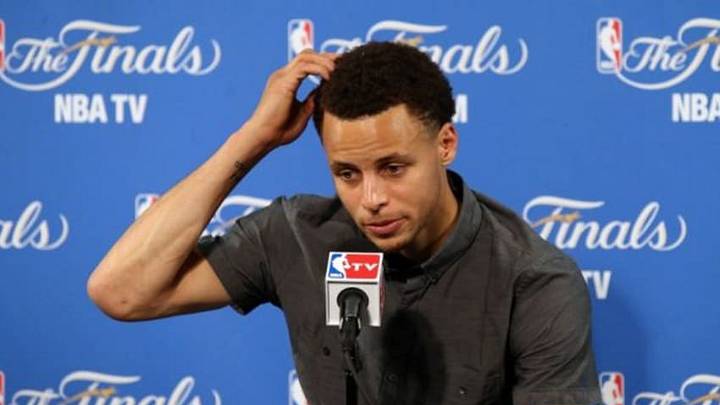
Stephen Curry‘s nightmare?
“Abysmal” may not even define this dreadful outing by Curry in Game 2. Golden State suffered just their fourth home loss of the 2014-15 campaign, with all four losses being by an average margin of six points.
If Curry didn’t have the most lamentable shooting night of his playoffs, their home record definitely improves to 48-3. It was just time for the basketball gods to remind the Bay Area that it’s been 40 years since their last trip here.

“Nothing can come easy” was the moral of Golden State’s Game 2, as “Chef Curry” stirred up a rare, disgusting dish. Normally, he’s cooking with ingredients you can only in Oakland, with either Splash Brother. However, he must have let his daughter Riley control dinner this time.
For the first time in Curry’s career, he attempted at least 23 shots and made less than 30% of them. Six other times in his career, Curry shot 23+ times in a game and made at least 34% of his looks, including once during this playoff run (Game 3 vs. New Orleans). But, nothing has reached the level we witnessed on Sunday.
In fact, it was just the seventh time Curry has ever shot more than 14 long-range bombs in a single game. Prior to Game 2, he had always made at least five of those 3-pointers in all six occurrences. On Sunday, only two found the bottom of the net, given him the most missed 3-pointers he’s ever experienced in a game.
To many degrees, you have to credit Matthew Dellavedova and his defensive artistry. Between he and Iman Shumpert, Cleveland has two gifted on-ball defenders that no shooter wants to mess with.
While Shumpert is considered the better overall defender based on his ability to anticipate a few seconds ahead of the play and break up passing lanes, Dellavedova is perhaps the biggest one-on-one nuisance to deal with.
Kawhi Leonard will rip your heart out and do it silently. Paul George will show off his length and finish a steal with a thunderous jam. Tony Allen will pull out all the defensive tricks and run back screaming “First team all defense!”
Dellavedova? He’ll just make a shooter want to scream and pull his hair out, and then rarely be an option on offense. He doesn’t care — he’ll get the enjoyment out of making a shooter’s game a living nightmare.
While many people will point to Golden State’s final halfcourt possession in overtime as “the defining play” for Dellavedova’s defense, what he was able to do to Curry went beyond that.
It goes beyond just contesting Curry’s shot, like Delly did at the end of the game. He literally suffocates Curry for 24 seconds of the shot clock, and ruins Golden State’s offensive trips:
In the clip above, notice where Dellavedova picks up Curry. It’s right on the Warriors’ inbound pass, with Delly even making body contact with him before they get into the halfcourt set. Those things matter, especially when you’re dealing with someone that’s 75-of-173 (43.3%) from 3-point range in the playoffs. Knowing that, Delly is aware that you have to attempt to get into the head of Curry, a little.
David Blatt has done a fabulous job with the game-plan on Curry, too. When Curry is trying to cut into the lane off a screen, Cleveland has shifted bodies into his direction so that no pass to Golden State’s hero is possible:

Here, you see Mozgov rotate up once he sees that Curry is coming around Bogut’s screen. Bogut is one of the best at this — holding the ball and getting a small defender caught instead of actually handing the ball off to Curry.
Curry runs right into the wall of Mozgov and James Jones, instead of having a clear cut to the paint. What this does for Delly and the Cavs is actually underrated: It allows Delly time to get around Bogut, and back to his man.
The most telling part of Delly’s defense on Curry in Game 2 was the ball denial. It’s one thing to not give him air-space on the deadly jumper, but it’s another thing to actually stop Golden State from delivering him the ball:

Draymond Green is looking to get the ball to Curry the whole time, because he’s aware they need to get a shot up in a hurry. The most important thing Dellavedova accomplishes in this possession is about to unfold.
Wasting the Warriors’ shot clock with lock-down defense.
Then, when Delly knows that a shot has to go up (with just two seconds left), completely closing out and not fouling.
One of the most overlooked components of basketball is on display here. Offenses become predictable once the shot clock contracts to below four seconds. More often than not, the player with the ball at that moment, is the one that has to take a shot. It becomes an all-out feast from there, as you can force yourself all up on a shooter and take his breathing space away.
You just have to be careful not to commit a foul. Delly isn’t one to make that mistake, while J.R. Smith isn’t as fundamentally sound in that area.
What’s Ahead?
From time to time, it’s fun to enjoy the occasional crazy, weird game. It makes sports that much more exciting, because everything that you believed was predictable is soon tossed aside.
But, it’s also important to understand aberrations. When something is so out of the ordinary, you often roll your eyes because it’s doubtful it will ever happen again.
When something is so extremely odd to where you KNOW it’s not going to happen again, there’s confidence that the next game will revert back to the mean.
That’s likely the case here.
This is how ridiculous Sunday’s Game 2 turned out to be:
In the last two years (188 total games), it was the 5th time Golden State’s defense has forced an opponent to shoot less than 33% from the field. That’s outstanding for their defense, and remarkable that they accomplished it in the Finals.
However, they’re now 4-1 in those scenarios, since they somehow managed to lose Game 2 to Cleveland. That’s borderline absurd for a team to win a game despite barely eclipsing 30% from the field.
In the other four times it’s happened, the Warriors had an average margin of victory of … 24 points:
- vs. Oklahoma City: Forced Thunder to shoot 30.6%, won by 26.
- vs. Los Angeles: Forced Lakers to shoot 32.5%, won by 19.
- vs. Sacramento: Forced Kings to shoot 32.1%, won by 33.
- vs. Sacramento: Forced Kings to shoot 30.8%, won by 18.
- vs. Cleveland: Forced Cavaliers to shoot 32.6%, lost by 2.
Similar to every Game 2 in the Finals these days, nothing seems sustainable.
For the Warriors, nothing that happened in Game 2 should be a cause for a city-wide panic. Even if Dellavedova is hounding Curry on every trip up the floor, expecting him to shoot that defectively in Games 3 and 4 would be a mistake.
For Cleveland, we know two things are indeed sustainable: LeBron James’ desire to carry the heaviest backpack he’s had in his career, and the fact that this is truly a gritty team to deal with.
Northeast Ohio wants to erupt, but don’t pop the champagne too early.
 Add us as a preferred source on Google