

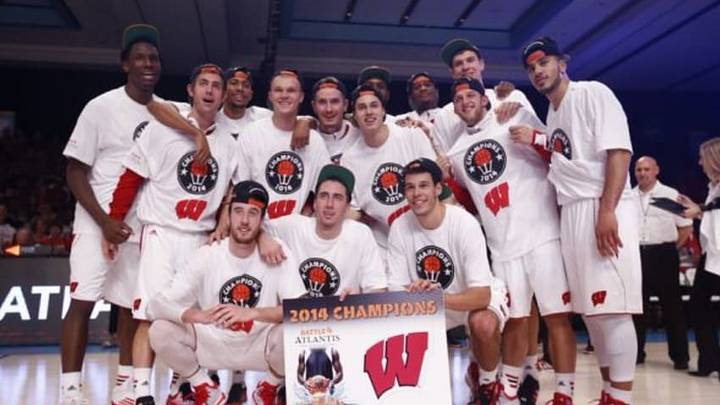
College basketball’s intensity and the interest of its fans usually picks up when conference season begins in January. However, recent history has shown that neutral court games and in-season tournaments are extremely valuable to teams hoping to win a national championship.
Most of college basketball’s viewership and most of the NCAA’s income comes with conference play. Rivalry games, TV revenue and increased viewership all play a factor in this. Fans, both casual and passionate, love to see their teams take on the evil team from down the road or just across the border. Games that can decide the difference between a conference championship or a middle of the pack finish gets most of the attention.

Those games, however, are just a small portion of a team’s resume, and if there’s one thing that’s been proven over the last few years, it’s that playing big games against good teams out of conference, away from any sort of home court advantage plays into a team’s NCAA Tournament seeding chances and increases the probability of cutting down the final nets that first Monday in April.
The process begins early in the season with the non-conference schedule. Most power teams, such as Duke, Kansas and Kentucky choose to play every game imaginable in front of their home crowd. Part of the reasoning is that it’s much easier to win at home and those teams have some of the best home records in college basketball over the past decade or so.
Another part of the reasoning is money, which is king for both college sports and the NCAA. The more games played at home, the more fans you’ll get coming to your games, the more tickets/merchandise/concessions you’ll sell and the more you can make off of the sport. Season ticket holders demand a certain number of home games and it’s easier for power teams to oblige.

Although home games are important to a program and a school, it’s the non-conference games and the in-season tournaments that ultimately decide a team’s success level.
Over the last 10 years, eight of the last 10 national champions have taken part in some sort of in-season tournament, whether it be the Maui Invitational, the 2K Classic of the NIT Season Tip-Off. Some of these tournaments are smaller than others, though.
Tournaments such as 2K Classic, Coaches vs. Cancer Classic and NIT Season Tip-Off has just four teams involved with two games of bracket play to determine a champion. Then there are tournaments such as the Maui Invitational, Battle 4 Atlantis and Puerto Rico Tip-Off have eight teams involved with bracket play, equaling three straight days of games.
Another stat that proves these tournaments work: while eight of the past 10 national champions have taken part in one of these in-season tournaments, seven of them have won their tournaments.
The exceptions to this since the 2005-06 season are: 2006-07 Florida (no tournament), 2007-08 Kansas (Jayhawk Invitational; all played at home and no power conference teams involved) and 2012-13 Louisville (took part in Battle 4 Atlantis, lost to Duke in the title game).
In all, winning a tournament in November — while some may see it as meaningless at the time — carries a lot of weight moving forward. Not only are these teams getting themselves prepared by playing multiple games in a short amount of time (three games in three days, games on back-to-back games, etc.) teams in these tournaments are also likely to get quality competition against a potential or future NCAA Tournament team.

For example, 2015 national champion Duke took part in the 2014 Coaches vs. Cancer Classic where they took down Temple and Stanford. Temple and Stanford, while failing to qualify for the NCAA Tournament, both advanced to the Final Four of the NIT with Stanford winning it all. So there’s your fun fact of the day: the two teams that were in the Coaches vs. Cancer Classic took home both the national championship and the NIT championship.
Other recent successors of the in-season tournament process are 2014 champion Connecticut (defeated Boston College and Indiana in the 2013 2K Classic) and 2012 champion Kentucky (defeated Penn State and Old Dominion in the 2011 Hall of Fame Tip-Off).
The tournament-style format is one aspect of the success of the teams involved. The other part is that the games are played on neutral courts.
Since all NCAA Tournament games are played on neutral courts, teams have to be prepared for being cheered against and having very little fans there at all. It’s something that teams haven’t been able to overcome in the NCAAs and leads to early exits because of being accustomed to having great fan turnouts in their favor.
For example: Iowa State. The Cyclones finished with a 25-9 record and were a favorite to make that surprise run to the Final Four. Unfortunately, 15 of Iowa State’s wins came at home while just one loss came while playing at Hilton Colesium. They finished with a 5-5 record on the road, all in Big-12 play, and just a 5-3 record in neutral court games.
Keep in mind that three of those wins came in the Big 12 Tournament, which was played in Kansas City and has a history of being pro-Iowa State crowds. It’s part of the reason why the Cyclones have won back-to-back conference tournament titles. They have the home court advantage in those games, but once the NCAAs start, it’s a whole different ball game.
Iowa State is not the only team to suffer from lack of road/neutral court success, but they are one team that will be scrutinized for it in the next few months. To combat this, the Cyclones are looking to schedule more non-conference neutral court games for the 2015-16 season, starting with playing Colorado in Sioux Falls at the Sanford Pentagon. Though that crowd is expected to be pro-Iowa State (their fans travel extremely well), it’s a start.
When looking at team resumes for NCAA Tournament seeding consideration, the selection committee does take into account a team’s ability to win away from home, on neutral courts and who they’re playing. While most teams don’t want to host games against other ranked opponents unless they are forced to (conference challenges and conference play), they’re entering themselves in tournaments to get those big games together and a chance to prove themselves.

Neutral court and in-season tournament games have grown into a big endeavor in college basketball. Soon there will be more of these tournaments in college basketball as their are bowl games in college football (unlikely, but trending upward). Teams want to be part of these tournaments to get their seasons started and they’ve become a staple in college basketball’s early season schedule.
History shows that these tournaments and neutral games are proving to be incredibly valuable with the success of teams that have taken part in them. Win one of these tournaments and your odds of winning the national title increases dramatically.
Don’t be surprised to see a few more of these tournaments and special events (i.e. Champions Classic with Kentucky, Duke, Kansas and Michigan State rotating games against each other) continue to pop up across the country. Their track record speaks for itself.
Next: The Biggest X-Factor On Every NBA Playoff Team
 Add us as a preferred source on Google