

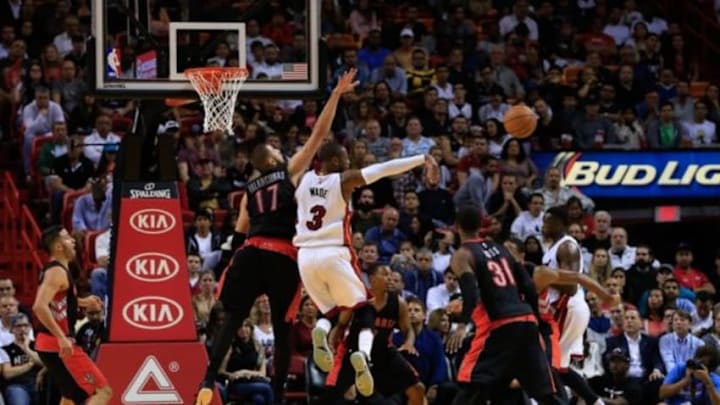
It was 2003 and the Miami Heat weren’t quite sure how to use Dwyane Wade.
Drafted fifth overall, the problem was that Miami needed a point guard that could feed Lamar Odom, Caron Butler and Brian Grant the ball regularly. Wade was too tall and his handle and passing was questionable.
In college, he could use his athleticism to get past opponents, rise up with the ball and, if need be, easily hit an open teammate.
That didn’t work so well during Wade’s rookie year in the NBA.
More from Hoops Habit
- The 5 most dominant NBA players who never won a championship
- 7 Players the Miami Heat might replace Herro with by the trade deadline
- Meet Cooper Flagg: The best American prospect since LeBron James
- Are the Miami Heat laying the groundwork for their next super team?
- Sophomore Jump: 5 second-year NBA players bound to breakout
Although still quicker than most, he had the tendency of getting caught up in the air, unused to the speed with which a defender could adjust to Wade’s movements. He’d have to force a pass, put up a bad shot or land with the ball still in his possession.
Turnovers and poor shot selection were the frequent result.
Ten seasons later and it’s obvious that Wade’s figured it out and is playing a key role in Miami’s redesigned offense. To the surprise of most, the Heat are ranked first in the league in total assists (167 through seven games) and third in team assists per game (23.9).
At the heart of it is Wade, leading the team at 6.9 APG. This is his fourth-highest mark in his career but his average per 36 minutes is actually ranked the highest.
Clearly, Miami is committed to distributing the ball more efficiently, especially in the absence of dynamic passer LeBron James.
But Wade’s numbers, in particular, shouldn’t be that surprising. As stated before, he’s tied or surpassed this season’s per game averages three times; a three consecutive-season span in between 2006-09.
That era, perhaps the most productive of Wade’s career, was an opportunity to shine as the team’s leading option following the trade of Shaquille O’Neal to the Phoenix Suns. Wade was the undisputed leader of the team and he was asked to do everything.
Not surprisingly, Wade’s lowest assist totals (with the exception of his rookie season) were during the “Big 3” era (2010-14) when James was the focal point of the offense. But with James off to Cleveland, the Heat has embraced a team-wide concept of passing that is being led by Wade.
Here are the highlights of Wade’s performance on Sunday, the young season’s signature victory over the Dallas Mavericks:
Put this 20-point, 10-assist performance in context — the game was the second of a back-to-back set (in which Wade logged 25 points and eight assists) and on the road.
Wade isn’t just cutting to the basket or hitting his patented turn-around jumper. He’s hitting teammates from the low post, cutting underneath the basket and finding open shooters in the corners…he’s even rising up, just like he used to, but drawing the double-team to hit an undefended teammate.
In short, he’s doing everything once again.
It might come as a surprise to people to have forgotten the Wade of pre-2010. It also might highlight just how much both he and Chris Bosh had to sacrifice in order to thrive alongside LeBron James.
But this version of Wade, the future Hall of Famer, is merely an evolution of the player he’s always been. At 5-2 and leading the Southeast Divsion, the Miami Heat are certainly thriving as a result.
Next: NBA Panic Meter: No Panic In Miami, Right?
 Add us as a preferred source on Google