

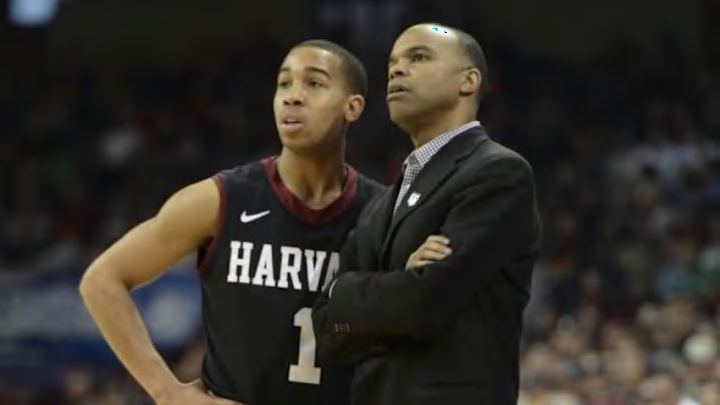
Not one, not two, not three — No, that’s not a reference to LeBron James’ famous Miami Heat prediction, rather it’s referring to the Harvard Crimson’s recent string of four consecutive Ivy League Championships.
Since winning a share of their first conference championship in 2011, the Crimson have been on a roll, winning conference championships and making the NCAA tournament in 2012, 2013 and 2014, and knocking off New Mexico and Cincinnati, respectively, in their two most recent appearances in the Big Dance.
What does Harvard owe its recent success to? Superb guard play, experience and gritty defense have all been factors in the Crimson’s run.
More from Hoops Habit
- The 5 most dominant NBA players who never won a championship
- 7 Players the Miami Heat might replace Herro with by the trade deadline
- Meet Cooper Flagg: The best American prospect since LeBron James
- Are the Miami Heat laying the groundwork for their next super team?
- Sophomore Jump: 5 second-year NBA players bound to breakout
Now a household name for reasons other than academics, simply winning the conference and making the NCAA tournament should not be considered a successful season. The Crimson have shown they can be competitive with the best, and with a roster good enough to be a top 25 team, should not settle for anything less than a Sweet 16 appearance this season.
But if Harvard wants to make a tournament run, it must first win the Ivy League for the fifth consecutive year. Can the Crimson do it? The short answer is yes, but it won’t be as easy as you may think. Harvard has some issues — such as lack of depth and shooting — it must sort out before crowing itself king of the Ancient Eight.
In tournament play, guard play, experience and sound defense are crucial. Harvard’s starting five features all three — the Crimson start four seniors and a junior, led by the backcourt duo of Ivy League Player of the Year Wesley Saunders and two-time all-conference performer Siyani Chambers.
Saunders was named the 2014 Ivy League Player of the Year, and stuffed the stat sheet on a nightly basis, averaging 14.2 points, 4.6 rebounds, 3.8 assists and 1.7 steals per game. He is a well-rounded two-way player that does a little bit of everything.
If Saunders has one flaw in his game it would be three-point shooting. Last year, Saunders connected on only 10 of 34 attempts. Luckily for Harvard, Chambers has proved to be threat from long range, which makes him a perfect backcourt mate to Saunders. Chambers is a career 39.8 percent three-point shooter, and is the one proven shooter on this year’s squad.
Chambers has also been the team’s facilitator on offense, posting a 2-to-1 assist-to-turnover ratio and averaging 4.6 assists per game last season. His playmaking ability is key to the success of the Harvard offense.
In addition to Saunders and Chambers, the Crimson boast the best frontcourt in the Ivy League, led by senior forward Steve Moundo-Missi. Moundou-Missi had his best season by far last year, averaging 10.5 points, 6.0 rebounds, and 1.3 blocks per game — all career highs. He was fourth in the conference in rebounding and third in blocks, earning his second selection to the All-Ivy Team. He will have the task of controlling the paint on both sides of the ball this season for the Crimson.
Harvard’s starting five is battle-tested in tournament play, but the weakness of the team is its bench, which lacks depth and experience. Junior forward Agunwa Okolie is the team’s most experienced substitute, and he only averaged 9.0 minutes and 2.6 points per game last season. If Harvard wants to be competitive this postseason, it must first find enough depth to support its starters.
The Crimson hope that help is on the way with freshmen Chris Egi and Andre Chatfield. Egi was a top 150 recruit who will be counted on from day one to provide help for Moundo-Missi in the post. Three-star recruit Chatfield will likely also have a chance to make an immediate impact for the Crimson, especially if he can display a consistent shooting stroke.
Along with depth issues, Harvard will also have to find shooters to space the floor. The Crimson lost Laurent Rivard, the best three-point shooter in school history, and Chambers is the only proven threat from long range on the roster.
To keep other teams from throwing constant zone defenses at them, the Crimson will need to develop shooters off the bench. Sophomore Corbin Miller will look for a bigger role this season, after connecting on 26 of 57 three-point attempts last season (45.6 percent). Miller and Chatfield have the best opportunity to step up and become significant contributors at the wing positions.
At the end of the day, defense will still be this team’s calling card. The Crimson had one of the best defenses in the country last season, ranking in the top 40 in efficiency, and should only improve this season. With length on the wings and plenty of bodies to throw at offenses in the post, the Crimson will be hard to score on.
If Harvard is able to find a shooting stroke and some depth on this year’s roster, it may find itself making another run in March. Its stingy defense will keep it in games, but it will be up to the Crimson to find enough offense to come away with victories. With a roster full of talent and potential at every position, there is no reason that Harvard can’t win the Ivy League for a fifth straight time.
If history is indication, they will.
Next: How Georgia State is Changing the Mid-Major Mindset
 Add us as a preferred source on Google